Progress claims
Construction progress claims software connected to the contract behind the claim
Palydin helps construction teams draft progress claims from live scope, cumulative progress, retention, GST, prior assessments, and contract history. The claim is not an isolated document - it stays tied to the records both sides need to verify.
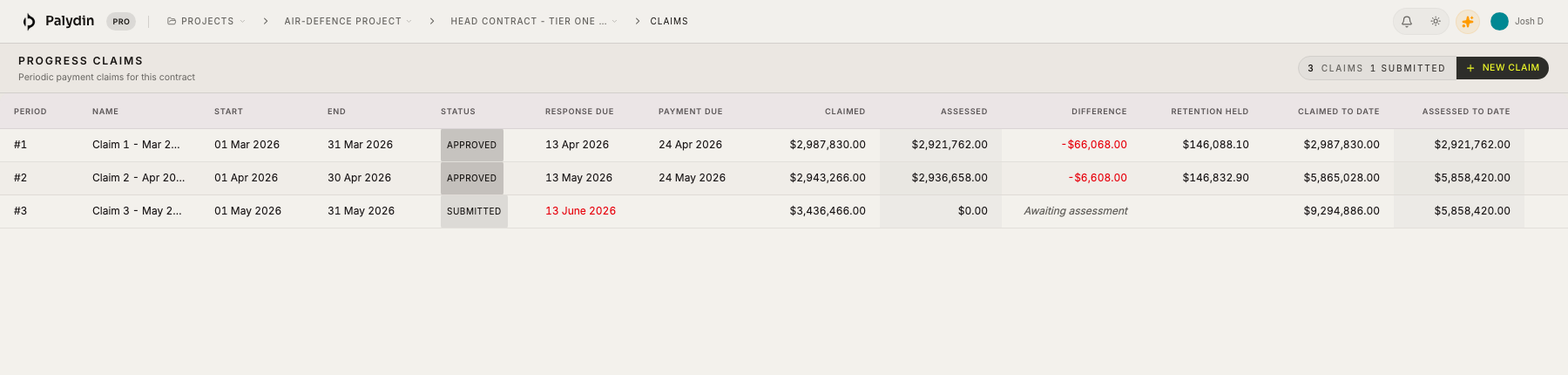
The old process hides the facts in the gaps.
Separate files, separate assessments, and no reliable shared record.
- 01
Spreadsheet claim assembled from copied progress data and old claim periods.
- 02
GST, retention, and previous assessment values checked by formula instead of record.
- 03
Emailed PDF submission with attachments split across threads.
- 04
Head contractor assessment rebuilt in a separate workbook.
- 05
Payment schedule reasons and audit history depend on file names, inbox search, and memory.
How Palydin handles it
A workflow for the full commercial day.
Step 01
Start with contract scope
Use the schedule of works, approved variations, contract terms, and documents as the basis for the claim.
Step 02
Open the claim period
Create the next progress claim against the same contract record, with claim numbering and period context kept in sequence.
Step 03
Carry prior assessments forward
Bring previous approved amounts, rejected amounts, reasons, and claim-to-date values into the current claim.
Step 04
Apply retention and GST
Keep retention deductions, GST, held amounts, and adjusted contract value visible before submission.
Step 05
Issue and audit the assessment
Support head contractor review, payment schedule reasons, and audit history from the same submitted record.
Every step stays attached to the same record:
Useful from either side of the contract.
Subcontractors
Draft claims from live progress, keep retention visible, and submit a cleaner record.
Head contractors
Review submitted claims against scope, variations, prior assessments, and compliance context.
Principals
See the basis of the payment claim without waiting for a rebuilt summary pack.
Built for Australian construction
Built around the records commercial teams argue over.
Palydin uses Australian construction language in the product: progress claims, retention, GST, payment schedules, and the claimant/assessor relationship between subcontractors, head contractors, and principals.
- Progress claims
- Claim periods, claimed-to-date values, prior assessments, supporting documents, and submitted status stay together.
- GST and retention
- Keep GST, retention deductions, held amounts, and release context visible inside the claim workflow.
- SOPA/payment schedules
- Track payment schedule context beside the claim, assessment reasons, contract terms, and audit history.
- Both sides of the contract
- Subcontractors can prepare the record. Head contractors and principals can assess from the same file.
- Audit trail
- Claim changes, assessment reasons, variation decisions, and retention activity stay attached to the record.
- Access controls
- Role-based permissions keep claimant, assessor, admin, commercial, and viewer workflows separated.
- Counterparty scoping
- External parties only work inside the contracts they are connected to, not the whole project portfolio.
- Contract-cited AI
- Answers point back to contract material so teams can check the source before acting.
FAQ
Direct answers for search visitors.
Verify the workflow before you talk to sales.
Start the Pro trial, load one contract, draft a real workflow, and decide from the product surface.